


Solar Street Light Procurement Guide for Overseas Contractors: How to Specify the Right Model for Rural, Municipal, Coastal, Industrial and Scenic Projects
Most failed solar street light tenders do not fail because the product is "cheap". They fail because the same integrated 60 W unit was copied from a village path into a coastal highway, an industrial access road and a tourist boardwalk - and then the salt spray, wind load, battery fade or lux uniformity killed the handover.
If you are an overseas contractor, EPC buyer or project lighting specifier sourcing from a China solar street light manufacturer, the first question is not "who is the most popular brand". The first question is: which configuration matches my site class?
This guide breaks down five field classes - rural electrification, municipal road, coastal/marine, industrial park, scenic/tourism - with the exact specs overseas contractors should put into a Bill of Quantities (BOQ) and supplier audit checklist.
Why "one solar street light for all projects" is a red flag
Online rankings for solar LED street lights are marketing surfaces. They do not tell you whether the lens was simulated in DIALux, whether the battery is Grade A LiFePO4 or recycled laptop cells, or whether the housing passed 1000 h salt spray.
A real engineering supplier should answer:
Can you provide IES photometric files + DIALux simulation for my road width and pole spacing?
Is the battery new Grade A LiFePO4 with cell grading, matching and BMS balance logs?
What is the IP and IK rating of the luminaire and battery box separately?
For coastal sites: what is the ISO 12944corrosion class (C4 / C5-M) and salt spray hour count (ISO 9227/ ASTM B117)?
For wind: do you supply structural calculation for local gust speed (EN 40-3or equivalent)?
For tenders: can you issue CE, RoHS, CB, IEC 61215, IEC 62619, UN38.3, IP/IK lab reports?
If the answer is "our light is universal", walk away.
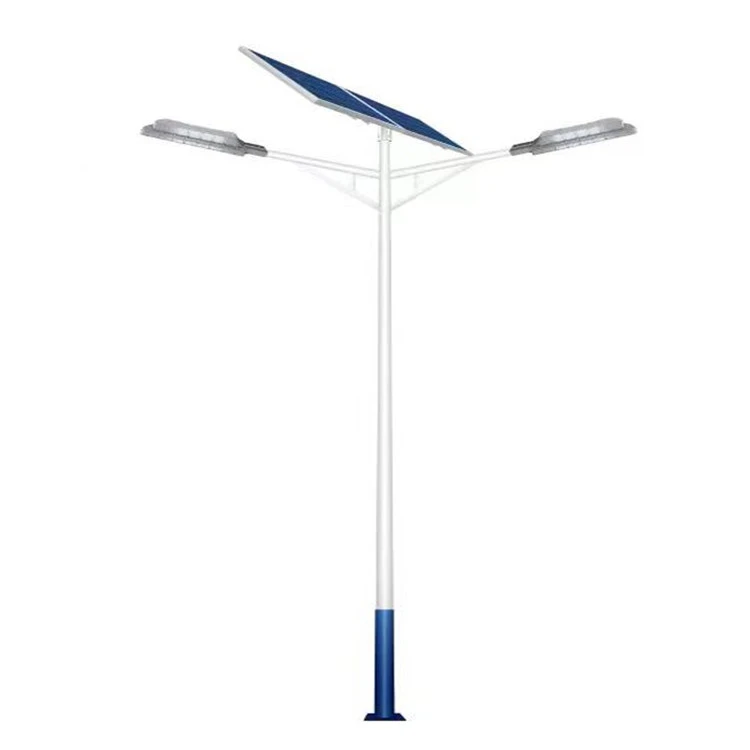
Six specs contractors should compare before asking for a quotation
|
Spec |
What good looks like |
Red flag |
|---|---|---|
|
Luminous output |
Delivered lumens, 150–180 lm/W, IES file supplied |
"100 W super bright" with no IES |
|
Battery |
Grade A LiFePO4, 2000+ cycles @80% DoD, IEC 62619, UN38.3 |
"Lithium battery" no chemistry, no cycle report |
|
Controller |
MPPT ≥98%, temp compensated, 6 kV surge |
PWM, no dimming profile |
|
Ingress |
Luminaire IP66/IP67, battery box IP67, IK10 for public sites |
Single "IP65" claim for whole unit |
|
Coast / corrosion |
C5-M coating, 316 stainless hardware, 1000 h salt spray |
Paint thickness not declared |
|
Documents |
DIALux sim, wind calc, datasheet, ISO 9001/14001, tender pack |
Only a glossy PDF |
Scenario 1 - Rural village road / off-grid community lighting
Typical buyer: NGO, rural municipality, telecom site access, agricultural coop.
Road width: 3–5 m. Pole: 6–8 m. Target: 5–10 lux functional lighting.
Spec recommendation:
30–50 W LED, 150+ lm/W, T2/T3 road optic
60–120 Wp monocrystalline panel
12.8 V / 25.6 V LiFePO4, 3–5 rainy days autonomy
All-in-one split or compact integrated, IP65/IP66, IK08+
MPPT controller with time-dimming
Failure mode overseas contractors see: 6 months in, half the village goes dark. Cause: second-life cells, no cell matching, no low-temp cutoff. Always ask for battery incoming inspection + grading record.
Scenario 2 - Municipal branch road / city street tender
Typical buyer: city hall, public works, World Bank / IDB funded lot.
Road width: 6–10 m. Pole: 8–10 m. Target: 10–20 lux, EN 13201 / local standard.
Spec recommendation:
60–100 W LED, IES + DIALux submitted with bid
Uniformity Uo ≥ 0.4, glare TI controlled
Split-type preferred for easier panel tilt and battery swap
IP66 luminaire, IP67 battery box, IK10
Grade A LiFePO4, IEC 62619, 5-year warranty in contract
Municipal lots live or die on photometric compliance. A 90 W lamp with bad lens fails uniformty; a 70 W lamp with correct batwing passes. Buy lumens and candela curves, not wattage.
Scenario 3 - Coastal / marine / beachfront promenade (e.g. Rio, Lagos, Jakarta, Karachi)
Typical buyer: port authority, tourism board, coastal municipality.
Stress: salt spray, high RH, UV, wind gusts, bird droppings, occasional flood.
Spec recommendation:
Housing: die-cast aluminum, ISO 12944 C5-M, DFT ≥80 µm, 316 A4 fasteners
Salt spray ISO 9227 ≥1000 h (1500 h for splash zone)
Luminaire IP67, battery box IP68 optional, ePTFE breather
Wind load calc for ≥45 m/s gust
Panel tilt adjustable (split type wins here)
This is where many "IP65 plastic all-in-one" units rot from inside in 18 months. Coastal solar street light procurement is a coating and gasket conversation first, a lumen conversation second.
Scenario 4 - Industrial park / oil & gas / mining access road
Typical buyer: EPC, plant owner, free-trade-zone developer.
Stress: vibration, dust, vandalism, vehicle impact, chemical haze.
Spec recommendation:
Split type, lockable battery cabinet, IK10
Q235/Q355 pole, hot-dip galvanized + epoxy + fluorocarbon (C5)
100–150 W LED, 12 h run + 3-day autonomy
Surge protection 6–10 kV, MPPT with RS485 / remote fault log
Optional NEMA socket for smart city upgrade
Industrial buyers care about OPEX. A battery you can swap in 10 minutes beats a sealed all-in-one you throw away.
Scenario 5 - Scenic area / hotel drive / cultural tourism boardwalk
Typical buyer: resort, park authority, landscape architect.
Stress: appearance, color consistency, wind on open lake/ridge, dimming mood.
Spec recommendation:
6–10 m pole, 30–80 W functional + warm-white 3000 K option
OEM/ODM housing finish, concealed bracket
Same LiFePO4 + IP67 base as municipal, plus batch color binning report
DIALux with shielded optic to avoid dark-sky complaints
Scenic projects rarely fail on brightness; they fail on rework because one batch is 3000 K and the next is 3500 K.
All-in-one vs split type - the contractor shortcut
All-in-one solar street light: fast install, low labor, anti-theft, good for rural/off-grid and tight budgets. Weak point: fixed panel angle, harder battery replacement, lower wind profile.
Split type solar street light: panel tilt optimized, bigger battery, easier maintenance, better for municipal/industrial/coastal. Weak point: more wiring, slightly higher theft risk if not locked.
For Latin America, Africa, SEA municipal tenders, split type with separate PV bracket is usually the safer engineering call.

Certifications overseas contractors must line up before shipment
Depending on destination:
EU / Mediterranean: CE, EN 60598, IEC 62031, RoHS, WEEE, CB
Middle East: IEC 61215 panel, IEC 62619 battery, CE, LM-80, IP/IK reports
Brazil: INMETRO holder via local importer; factory supplies IEC + CB + UN38.3 + CE for OCP conversion
Africa: CE + IEC stack + UN38.3 + tenderer-specific SONCAP/PVoC
Global baseline: ISO 9001, LM-80, IESNA IES, DIALuxfile, salt spray, wind calc
Never accept a "CE" sticker without the test report number and lab name.
Supplier audit checklist for contractors
Factory or trader? Ask for PACK line photo + cell batch ledger.
Request one full tender pack (datasheet, IES, DIALux, IP/IK, salt spray, battery cycle, wind calc, ISO).
Ask for reference project in same climate class (coastal? tropical? municipal?).
Confirm warranty in PI: 5 years standard, extension in contract, spare parts FOB price.
Sample before container: 1 unit coastal build + 1 unit municipal build.
Bottom line for the BOQ
Rural: buy autonomy + cell grading
Municipal: buy IES/DIALux compliance + IP66/IK10
Coastal: buy C5-M coating + 1000 h salt spray + IP67
Industrial: buy split type + lockable battery + surge
Scenic: buy color binning + OEM finish + DIALux shielding
Specify by site class, not by Alibaba rank. The right China solar street light manufacturer will ask for your road width, pole height, wind speed and target lux before quoting - that question alone filters out 60% of unfit suppliers.
Meta title: Solar Street Light Procurement Guide for Overseas Contractors – Rural, Municipal, Coastal, Industrial, Scenic Specs
Meta description: How overseas contractors specify solar street lights by site class: LiFePO4, IES/DIALux, IP67 C5-M, IEC 62619, split vs all-in-one, tender document checklist.
URL slug: /blog/solar-street-light-procurement-guide-contractors


