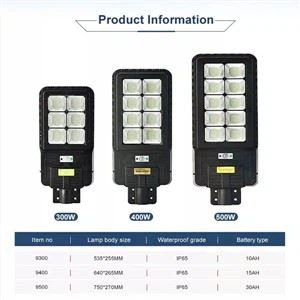
As a provider of straight solar street lights, I'm often asked about how these innovative lighting solutions perform in low - light conditions. Understanding this aspect is crucial, especially for areas facing short daylight hours, frequent overcast skies, or those deep in the heart of urban landscapes where light could be obstructed.
The Basics of Straight Solar Street Lights
Before diving into low - light scenarios, it's essential to understand the fundamental working principle of straight solar street lights. These lights rely on photovoltaic (PV) cells, typically installed on top of the light fixture or a nearby panel. During the day, these PV cells absorb sunlight and convert it into direct current (DC) electricity. This electricity is then stored in a rechargeable battery, usually a lead - acid or lithium - ion battery, for later use. When the ambient light level drops below a certain threshold, a light - sensing device, known as a photoresistor or a more advanced sensor in modern models, triggers the street light to switch on and draws power from the stored energy in the battery.
Challenges in Low - Light Conditions
Low - light conditions pose several challenges to straight solar street lights. Firstly, there is less sunlight available for the PV cells to convert into electricity. This reduces the amount of energy that can be harvested and stored in the battery during the day. Second, extended periods of low light might mean that the battery is not fully charged, which could lead to reduced lighting runtime, or in extreme cases, the light might not function at all.
How Straight Solar Street Lights Overcome Low - Light Challenges
Advanced PV Cell Technology
Modern straight solar street lights are equipped with high - efficiency PV cells. These cells are designed to capture and convert a larger percentage of the available sunlight into electricity, even in low - light conditions. For example, monocrystalline silicon PV cells have a high conversion efficiency and can perform better in diffused light compared to other types. Some PV cells also come with anti - reflective coatings, which help to increase the absorption of sunlight, making them more effective in overcast or hazy conditions.
Energy - Efficient LED Lights
The use of light - emitting diodes (LEDs) in straight solar street lights is a game - changer. LEDs are highly energy - efficient, consuming significantly less power compared to traditional lighting sources like incandescent or fluorescent bulbs. This means that the stored energy in the battery can be used more effectively, providing longer lighting hours even when the battery is not fully charged. Additionally, LEDs have a longer lifespan, reducing maintenance costs and ensuring consistent lighting performance over time.
Intelligent Battery Management Systems
A good battery management system (BMS) is crucial for straight solar street lights in low - light conditions. The BMS monitors the battery's state of charge, temperature, and voltage. It ensures that the battery is charged and discharged in a safe and efficient manner. In low - light situations, the BMS can adjust the charging and discharging parameters to optimize the use of the limited energy available. For example, it can reduce the charging current to prevent over - discharging of the battery, which could damage it and reduce its lifespan.
Adaptive Lighting Control
Many of our straight solar street lights are equipped with adaptive lighting control systems. These systems can adjust the brightness of the light based on the ambient light level and the time of day. In low - light conditions, the light can be set to a lower brightness level during the early hours of the night when there is less traffic or activity. As the night progresses and the need for light increases, the brightness can be gradually increased. This not only saves energy but also ensures that the light provides adequate illumination when needed.
Real - World Applications and Case Studies
Let's take a look at some real - world examples of how our straight solar street lights perform in low - light conditions. In a coastal town with frequent fog and overcast skies, we installed a series of straight solar street lights. Despite the limited sunlight, the high - efficiency PV cells were able to capture enough energy to keep the batteries charged. The LED lights provided bright and consistent illumination throughout the night, and the adaptive lighting control system adjusted the brightness based on the actual lighting needs, saving energy in the process.
In an urban alleyway with tall buildings on either side that blocked direct sunlight, our straight solar street lights still functioned well. The PV cells were able to capture the diffused light, and the intelligent battery management system ensured that the battery was used effectively. The result was well - lit alleyways, improving safety and visibility for pedestrians and cyclists.
Related Products
If you're interested in other types of street lighting solutions, you might want to check out our Induction Street Light. These lights offer unique advantages in terms of energy efficiency and lifespan. Another great option is our 120W Installation Of 10 Meters High Pole Solar Street Light, which is suitable for large - scale outdoor lighting projects. And for those who need a complete solution, our Solar Street Light with Pole is a convenient and cost - effective choice.
Conclusion
In conclusion, straight solar street lights are well - equipped to handle low - light conditions. Through the use of advanced PV cell technology, energy - efficient LEDs, intelligent battery management systems, and adaptive lighting control, these lights can provide reliable and sustainable lighting even in challenging environments. Whether it's a foggy coastal area or a shaded urban alley, our straight solar street lights can meet your lighting needs.
If you're interested in learning more about our straight solar street lights or are considering a purchase for your project, we encourage you to reach out for a detailed discussion. We're here to help you find the best lighting solution for your specific requirements.


References
[1] Diggelmann, A., & Rapp, A. (2019). Solar energy systems for the built environment. CRC Press.
[2] Kreith, F., & Goswami, D. Y. (2018). Principles of solar engineering. CRC Press.
[3] Luque, A., & Hegedus, S. (Eds.). (2011). Handbook of photovoltaic science and engineering. John Wiley & Sons.