Hey there! As a supplier of 80w solar street lights, I've seen firsthand how temperature can have a big impact on their performance. In this blog, I'm gonna break down how different temperatures affect these lights and what you need to know.
Let's start with the basics. Solar street lights work by converting sunlight into electricity through solar panels. This electricity is then stored in a battery and used to power the LED lights at night. But temperature can mess with each of these components in various ways.
High Temperatures
When it gets really hot outside, say above 30°C (86°F), it can be a real challenge for 80w solar street lights. First off, the solar panels take a hit. Solar panels are made up of photovoltaic cells that convert sunlight into electricity. These cells are sensitive to temperature. As the temperature rises, the efficiency of the solar panels drops. This means they produce less electricity for the same amount of sunlight.
For example, most solar panels have a temperature coefficient that shows how much their efficiency decreases with every degree increase in temperature. A typical value might be around -0.5% per °C. So, if the temperature goes up by 10°C, the solar panel's efficiency could drop by about 5%. That's a significant reduction in the amount of electricity it can generate.
The battery is another component that suffers in high temperatures. Most 80w solar street lights use lead - acid or lithium - ion batteries. In high heat, the chemical reactions inside the battery speed up. This can lead to faster self - discharge, which means the battery loses its charge even when it's not being used. Over time, high temperatures can also cause the battery to degrade more quickly. The electrodes inside the battery can corrode, and the electrolyte can dry out, reducing the battery's capacity and lifespan.
The LED lights themselves can also be affected. High temperatures can cause the LED chips to heat up, which can lead to a phenomenon called thermal droop. This means that the light output of the LEDs decreases as they get hotter. So, your 80w solar street light might not shine as brightly as it should on a hot summer night.


Low Temperatures
On the flip side, cold temperatures also pose problems for 80w solar street lights. When it's cold, say below 0°C (32°F), the solar panels don't generate as much electricity either. The cold can make the semiconductor materials in the photovoltaic cells less conductive, reducing their ability to convert sunlight into electricity.
The battery is even more affected by cold temperatures. In cold weather, the chemical reactions inside the battery slow down. This means that the battery can't deliver as much power as it can at normal temperatures. The capacity of the battery also decreases. For example, a lead - acid battery might only be able to deliver about 50% of its rated capacity at - 20°C.
The LED lights can also have issues in the cold. Cold temperatures can make the light output of the LEDs less stable. The color of the light might change, and the light might flicker or not turn on properly.
How to Mitigate Temperature Effects
As a supplier, I know it's important to find solutions to these temperature - related problems. One option is to use high - quality components that are designed to perform well in a wide range of temperatures. For example, some solar panels are specifically engineered to have a lower temperature coefficient, so they're less affected by heat.
When it comes to batteries, Lithium Iron Phosphate Battery Integrated Solar Street Lights are a great choice. Lithium iron phosphate batteries have a better temperature performance compared to lead - acid batteries. They can operate in a wider temperature range and are less prone to self - discharge and degradation in high temperatures.
Proper installation is also crucial. Make sure the solar panels are installed in a way that allows for good ventilation. This helps to keep them cool in hot weather. The battery should be installed in a well - insulated box to protect it from extreme temperatures.
Other Considerations
It's not just the extreme temperatures that matter. The daily temperature fluctuations can also have an impact. For example, if the temperature varies a lot between day and night, it can cause stress on the components. The expansion and contraction of the materials due to temperature changes can lead to mechanical failures over time.
Some 80w solar street lights come with built - in temperature sensors and controllers. These can adjust the charging and discharging of the battery based on the temperature. For example, in high temperatures, the controller can reduce the charging current to prevent overheating of the battery.
Different Models and Their Temperature Performance
We also offer other models of solar street lights that might be more suitable for different temperature conditions. The Model Integrated Solar Street Light 90w has a more advanced design that can handle temperature variations better. It has a larger solar panel, which can compensate for the reduced efficiency in high temperatures.
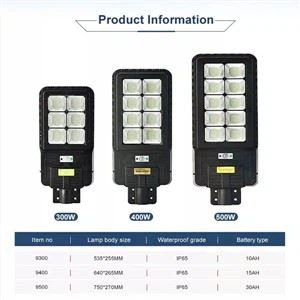
Our 300W 400W 500W All In One Integrated Led Solar Street Light series is also engineered to perform well in various climates. These lights use high - quality components and advanced thermal management systems to ensure stable performance in both hot and cold weather.
Conclusion
Temperature plays a crucial role in the performance of 80w solar street lights. Whether it's high heat or cold, each extreme can have a negative impact on the solar panels, battery, and LED lights. But with the right components, proper installation, and advanced technology, these effects can be minimized.
If you're in the market for solar street lights and want to ensure they perform well in your local climate, don't hesitate to reach out. We're here to help you choose the best model for your needs and provide all the support you need. Whether it's for a small residential area or a large commercial project, we've got the solutions. Contact us to start a purchase negotiation and let's light up your space with reliable solar street lights!
References
- Duffie, John A., and William A. Beckman. Solar Engineering of Thermal Processes. John Wiley & Sons, 2013.
- Luque, Antonio, and Steven Hegedus. Handbook of Photovoltaic Science and Engineering. John Wiley & Sons, 2011.
- Jain, Suresh C. LED Lighting: Technology, Applications, and Future Prospects. CRC Press, 2014.